Just a quick update for you all: Hurricane Sandy has pummeled Haiti, arriving Wednesday, and has stayed around for two days now. We in Tabarre are safe and as comfortable as we can be under the circumstances! I am grateful for a dry, sturdy home to sleep in and we are being catered to by our Haitian counterparts, who are working hard to keep our elecricity and water going and to provide us with clean drinking water, which will become very important in the following days. We have had HUGE amounts of rain and massively high winds. We are lucky here, however. Much of the country, especially the mountains above us, (our home in Kenscoff) and in the provinces, especially to our west, has taken a much worse hit. Rivers are overflowing, homes are falling and people are essentially stuck where they are because of flooding. The tent cities are saturated, as you might imagine. I try to see myself riding out this storm in a home made of trash bags with a dirt floor, and I cannot fathom it.
I was able to speak with my nurses from the clinic at FWAL, and they are well so far. The floods uphill and in neighboring towns have kept one of them from being able to travel to work. Numerous adjunct employees of NPH have not come to work these last two days. The hospitals are anticipating a rise in the number of cholera patients, as cholera is carried in the water. School has been closed since yesterday, on order of the President. We are hoping that each blast of rain will be the last - please keep the prayers and good thoughts coming our way as we dry out, survey the damage and provide assistance where we can. Fr. Rick and his team were already out in the tent cities yesterday, providing supplies to those in most desperate need.
More updates to come as I have them.
Friday, October 26, 2012

Tuesday, October 16, 2012
Hands
I was thinking the other day that I miss being able to give good
massages. As part of my curriculum back in the days of my first college major,
Athletic Training, we were trained in massage. I absolutely loved being able to
use my hands to alleviate pain and provide tangible therapy to the athletes
under my care. But even more, I think now and realize, I treasured being able
to touch them and offer that as a service as well. As I work here, and as I
have thought before, there is a poverty of love in our world, and one of the
ways we suffer is by lack of loving physical touch. A few friends of mine
definitely possess the gift of touch. When I am touched by them, I can sense
their love. But I also notice that because I am not in a place to receive
regular physical affection from my friends, I may jump or startle when first
touched. The kids I am with on a daily basis thrive on the warmth of physical
touch. Their hands and arms and legs are intertwined with mine before I can
react, and their hugs are given with all their strength. Just this morning I
got to sit with one of my favorite little girls at mass, and she ran her
fingers across my skirt, studying my arms and hands and then burying her face
against me as we stood. It is only natural to hold her close, my hand on her
back as she giggled against my waist. I finally had some baby time with our
little Francheese, who is usually being passed from teen girl to teen girl. She
clapped her hands against mine then cried to be turned and tuck her head into
my shoulder as she then stroked my arm with her tiny fingers.
 |
| Wasson, our new little baby boy! (We had no little boy baby clothes yet). |
The time since my return to Haiti has been a constant sea of change,
with volunteers leaving, a new schedule to keep, a return to hospital nursing,
a crash course in pediatric oncology, a different culture of nursing to learn,
new nurses to befriend, and most recently, a move into new volunteer housing.
Our new places are very cozy, but a tad warmer than our previous ones – the
challenges of being spoiled by air-conditioning, then having to leave it! My
face is beginning to resemble that of my adolescent self; therefore the photos
including me will be kept to a minimum for a bit! By no means are we suffering
– just adjusting. And we are appreciating cold water, ice and cold drinks at an
entirely new level. (Yet one more thing that we do not think twice about in the
US, but that billions of people live without, so much that my nurses were
taught that if medications are taken with cold water they will not work - it is
such a rare luxury here). I am now only
a few minutes’ walk from FWAL, but a longer commute from the hospital. But I do
enjoy making a house a home, and have enjoyed a bit of housekeeping. The walls
are a nice warm yellow, which my friends will know I appreciate. The staff is
working tirelessly to accommodate the nearly constant demands which we ex-pats
are so good at making, and I now have a fabulous front and back porch to enjoy!
 |
| The new digs, Villa Francesca |
 |
| My new front porch! |
I am now spending half my time familiarizing myself with the Oncology
ward at St. Damien. This is the only pediatric oncology program in the entire
country. Two passionate and assertive doctors run the program, assisted by a
dynamic and straightforward nurse supervisor.
My mornings are spent rounding on each of the patients, reading up on
their histories and working through their care plans, meeting with parents of
new patients and observing the nurses as they work. I am learning massive
amounts each day about the culture of nursing here, the demands placed on
families, the sheer challenge and obstacles of a fatal disease in the
developing world, the acceptance, submission and the simplicity of faith which
are extraordinary. Numerous cancers are
treated here, including leukemias, lymphomas, retinoblastomas, (cancer of the
eye), Wilm’s Tumors, neuroblastomas, and osteosarcomas (cancer of the bone).
Sadly, however, many children are not brought to the St. Damien program until
their cancer is in a very advanced stage, after parents search country-wide for
answers to the mysterious symptoms present in their child. Therefore, I was
asked to join the staff and help to form a Palliative Care program, so that the
children who are determined to be in a terminal state can be treated and
supported well.
Palliative care is essentially the support of the whole person and the
numerous aspects of a patient and family’s life in the presence of chronic or
acute illness. In the States, many resources are available and there is often a
multi-disciplinary team consulted to begin planning and implementation of
Palliative Care. The patient does not need to be in an advanced state of
illness to benefit from Palliative Care – ideally, it will begin at the time of
diagnosis, in order to provide for and accommodate the many issues which
develop with the onset of illness. These include spiritual care, pain and
symptom control, physical and occupational therapy, emotional support,
continued schooling, art therapy, decision-making and social support, and the
continuous process of educating the family.
There is, of course, a large disparity of resources and care available
to the children and families here. But the directors of the Oncology program
feel very strongly that this does not mean that the children entering the final
stages of life, and even at the start of their treatment, should be forgotten
or abandoned in such a state of weakness and pain. I am honored to be able to
work with them and to begin training the nurses in this approach to care. This
is a slow process, because before anything else, the development of a relationship
must take place. I am getting to know the nurses, learning how they operate,
observing the relationship between the nurses and doctors, asking oodles of
questions as I learn an entirely new area of medicine, and my ultimate favorite
thing, sitting with the kids. They are among the strongest, bravest people I
have ever met, smiling and nervously approaching the pale-skinned lady as they
laugh. They proudly show me their “picky” scars and are glad to oblige when I
tell them to slap my hand and give me a picky too.
 |
| Susanna, one of my newest friends |
 |
| My buddy Christo |
The hospitalized child is often very fearful, and carefully watches
any approaching person wearing scrub pants or a lab coat. But there is gentleness and power in an
outstretched hand. Too often we forget in the rush of tasks to pause
for this, and we quickly begin examining a patient instead of approaching them
gently. All of my relationships here in Mango, as the Oncology ward is labeled,
(each room is labeled with an item, due to the very low rate of literacy, as to
accommodate the large number of citizens here who can recognize a picture but
not a number or letter), have begun with the simple gesture of that
hand outstretched. The kids tentatively and slowly bring their hands to mine, explore
my fingers, find my rings, smile and glance back for the security of mom’s presence,
and then slowly start talking. The absolute highlight of my week was the sight
of a new little friend, Christo, as he recognized me at the top of the stairs,
and despite the huge tumor in his abdomen, leapt up the remaining steps to wrap
his arms around my neck and hug me with all his might! We exchanged squeezes as
we traveled down the hall toward the room where he knew he would have to
receive chemotherapy and blood draws, but his smile and instant demand for candy,
as he saw it last week in my bag, made me laugh. When we first met, he was
terribly scared, but we played through the rungs of his crib and I offered him
stickers, which he promptly placed all over his t-shirt. He then showed me his
juice and his food. He screamed as he was examined, and then when his blood
transfusion was started, and he reached for my hand to hold. What a thrill to
gain his trust and then converse with him for the rest of the morning through
the door of the office which adjoined his room – that was just the beginning!
Now he comes to find me as soon as he arrives, demanding that I feed him his
morning spaghetti and sit with him while he watches TV. We snuggle together as
he sits on my lap while I work. I was able to sit with his mom and assess how
much she understands about his disease, which helps me to understand what the
parents’ impressions are of what they are told by the doctors, what they hear
and what they interpret from the big words and scary prognosis. This is nursing
– what is done in the minutes and hours between doses of medication and vital
signs, the constant assessment of the patient and family, the sitting and
talking and ministering to them, validating their experience and fears, meeting
them just as they are, and providing the answers which we do have in our
possession. It is comforting and
encouraging when the easy answers are not there, sharing from our experience,
giving insight and counsel while respecting the uniqueness of their situation
and remembering that we can never understand exactly how they feel.
I was always a
little bit proud of my hands – I thought they were attractive and strong, and
my nails have always grown nicely. Then when I entered the hospital setting in
the US, nail polish was strongly discouraged and I had to give it up. On a stupid impulse one afternoon, I grabbed
a razor in our inventory room, and as I was opening it, it sliced my finger
just so perfectly that a ridiculous series of events ensued. For two hours, a
blood pressure cuff was fully inflated and cut off the circulation to my lower
arm while attempts were made to stop the bleeding and my blood vessels were
cauterized. A nerve block was given, and
the wound was then wrapped too tightly for the next 24 hours. This produced a
massive wound resembling a burn injury, put me within days of receiving a skin
graft, and deemed me unfit to work for an additional six weeks. I was terrified that I would not regain sense
or motor ability in that finger and that my hands would be forever stained by
my incompetence to handle a tiny sharp object. More than that, though, I feared
that I would not be able to use my hands to support patients through the most
basic tasks, holding them, assisting them in movement, offering massage to
friends, even typing on a computer keyboard or carrying equipment. Again, we do
not think twice about using our non-dominant index finger, but it is a pretty
necessary component of daily life! But now, two years later, I offer it easily to
the tiny hands that timidly grasp it. It is held for security during a scary
procedure. I hold the bottle to feed our
babies, I balance the numerous supplies and carry them from storage to the
clinic, and my little Erline leaps into my arms. I hold Valson and he steadies himself
before jetting away, I caress little faces and am led to a seat in the large
waiting area and handed a spoon to feed Christo, and I adjust my camera to take
photos of the endless poses the children eagerly enter.
 | ||
| Rosenie (r) with Stephanie, one of our newest little ones |
 |
| Baby Francheese with Sonya, employee of NPH Germany |
Some days I sit just craving a hug from a friend or the strength of
their hand as it lovingly squeezes my arm and rests on my back. The volunteers
hold hands at mass on Sunday evenings, reciting the Lord’s Prayer over the
bodies of our recently deceased brothers and sisters. Any of 200 residents of
the FWAL program will grasp my fingers as soon as they encounter me. Little
Antoine tells me he has a “malade” (problem) with his finger, which is easily
remedied with a kiss and a little bit of water. Fabienne and Mama lovingly make
me bracelets. The cancer patients give me “five” as hard as they possibly can.
I deal out the cards in our game of Uno. I examine the knee of a visitor who
has fallen. I wash and dress the newly-burned chest of a school student. I
cherish the delicious Haitian 7Up as I drink it. We cannot possibly count the number of times
we use our hands throughout the day, but perhaps we can be a bit more conscious
of how we use them and to whom we offer them, outstretched in friendship or
offered in prayer, holding pen to paper in the quickly disappearing act of a
handwritten letter, dignifying others through acts that confirm the genuineness
of our words.
Sunday, September 16, 2012
Love Out Loud
“I love you.” Three words which, when said in sincerity cannot be heard
too often; but only when actually demonstrated to be sincere and genuine. In
too many relationships and situations, we forget to seek the best for the
other, becoming too absorbed with ourselves. Then, how can those words be
received with trust and believed?
It’s been a whirlwind of a two months, a bit surreal and yet all too
present. I spent the month of August at home in Michigan, attempting to be
present to my family and friends – and for the first two weeks I felt like I
was in a dream state, searching for energy to function in such an ordered and
organized society. Let me explain to you that this experience and life feels so
removed from my life in the States that it takes days for me to realize that
Haiti and the United States are actually on the same planet, let alone only a
few hundred miles from each other. My body and mind were screaming for a chance
to process this past year, and to discern whether and for how long I should
continue to work here. The heaviness and sheer intensity of the last twelve months,
coupled with my disbelief that a year actually passed so slowly and so quickly
at the same time, caused me to pause and simply attempt to breathe once I got
home. The modern conveniences of life in the States were a welcome gift, and
yet the ever-present amazement at the overwhelming surplus of ridiculous
“stuff” we Americans apparently “need” did cause slight nausea with occasional
moments of dizziness as I re-entered the mall and supermarkets near my house. More
than 300 types of cheese in one store? Fruit and vegetable spray – captioned
“the soap you can eat,” even the menu at Starbucks (don’t get me wrong – I
indulged in several fabulous Coconut Soy Mochas, thank you very much!), were
causes for a step back and a deep breath. I did very much enjoy my delicious
burger with goat cheese on my first day at home, and pretty much every meal I
ate – the variety of foods and drinks is just plain stunning. And the shoes! I
did not know that I loved shoes so much as when I had been away from the world of
fashion for a year. I found myself looking longingly through my mother’s design
magazines, wishing for walls to paint fabulous colors and for walks through the
vintage stores to furnish a new place. These distractions served a two-fold
purpose, I can look back now and realize. I do cherish the freedom and stability of a
life in the US, and when I am called to return there, I will have a wonderful
time setting up house again and creating a cozy place to live and to welcome
friends. But yet, I also know now what freedom is present in a world with very
few possessions, where the emphasis is placed on not things and materials and
the latest fancy phone or car, but on the moments spent with children and
friends in relationship, moments which cannot possibly be bought or held in
time by the amount of books or the most comfortable couch.
 |
| Mangos! So messy and so delicious! |
 |
| My awesome pupil Stevenson, who remembered all of his letters and numbers! |
It was wonderful to re-connect with friends and to hear their vocal
support of my life and service. It is all too easy to forget that I am
remembered and loved from thousands of miles away when I sit sweating in
stifling heat and wonder if the internet is functional anywhere today, when my
new roommate finds other work and the circle of volunteers grows smaller, when
the same children are living in a hospital room labeled “Abandoned” for months
at a time, when temporary tents are removed to make way for parking lots, when
daily mass is most definitely a funeral for tiny bodies and the stench of death
has permeated the entire chapel, when new security measures are present at the
hospital due to escalating crime, when cholera spikes after Tropical Storm
Isaac, when cancer patients cannot receive their medications due to delays in
deliveries, when the groups of boys lie prostrate in front of the UN gates
awaiting the soldiers’ leftover food, when hit with the total chaos of the
Port-au-Prince airport upon arrival. To sit holding new babies only seen previously
in photos, to be touched and listened to by hands and hearts that know me from
outside this tiny island, was a massive blessing that I just wanted to somehow
package up and bring back to Haiti with me. It is one thing to hear or read
those three little words, but yet an entirely different experience to sit with
those who say them and be tangibly loved, understood and pursued.
The two weeks since my return have been equally as surreal as my visit
home. After only a few minutes in-country, it is hard to remember that I spent
a month Stateside. The visits with friends, the weddings, the fundraising
parties, seem years away already. Part of my dread in returning was that re-entry
is like a blow to the chest – it hits hard from the outset, with the harsh sun
and the blatant poverty, with the emotions and fatigue of my fellow volunteers,
with the desperation which we work to empower our brothers and sisters to
overcome. However, the endless stream of massive hugs and kisses and questions
heaped onto me by the children who are overjoyed that I kept my promise to come
back, serve to ease the sting a bit. Erline’s huge smile as she envelops my
legs in her arms. Little Stanley’s constant presence every moment I am at St.
Louis. The well-meaning staff which tells me I have come back fatter. The
delicious corn meal with bean sauce that is served for lunch. The hospital
staff as they stop me and tell me it is so good to see me again, that I am
remembered by them, and as they ask after my family and if I had a good
vacation. The concerned and gentle reprimands of more seasoned volunteers who
tell me change is inevitable and to not be afraid: these are all serve as
remedies as well. And as I sit in my house after a massive deep-cleaning of my
roommate’s now empty room and unpack the groceries from a Sunday supermarket
trip, where goat cheese (mmm!!) and filters for my new coffee maker were successfully
found, as were bananas and yogurt and sweets for the kids, and I listen to the
fantastic mix of current American music hits so lovingly put together for me, I
am amazed that only a few days have gone by since my arrival.
Within the next few weeks, we will be moving to new volunteer houses,
about ½ mile away from the hospital, and which are yet to receive electricity and running
water. The tents that stood for nearly three years to house short-term
volunteers have been taken down. My current house will soon be turned into
additional hospital space for the overflow of chronic patients. I am now
splitting my time equally between the Angels of Light Program and the Oncology
unit at St. Damien, working with an awesome team of doctors and nurses, and
dangerously at risk of falling in love with a whole new group of little heroes.
I absolutely love being back in the hospital and am being inundated with new
observations and thoughts as we begin coordinating a Palliative Care program
and I sort through the differing cultures of the American setting and the
Haitian patient and family. One of the things I have always loved about the
developing world is that it is nuts and bolts – the basics at work, with
limited resources but unlimited chances for relationship and critical thinking. This
culture tests even the best assessment skills and challenges the provider to
seek thorough answers with minimal information. There is no quick computerized
result here, no available x-ray posted within minutes of its completion. If
narcotic pain medications have been donated, there is a chance to control
severe pain; otherwise it is the basics and the comfort of a mother’s or
caregiver’s touch which must suffice. The staff here is stalwart, strong and
amazingly resourceful, creative and enthusiastic but firm and determined. The
kids have strength that puts mine to shame, smiling through unimaginable pain
and enduring the daily blood draws and chemotherapy effects with minimal tears.
They come from all over the country, having been referred from place to place
before finally learning that there is a cancer treatment facility in Haiti.
 |
| Do not mess with a boy and his beach ball. |
 |
| Jessica and Sabine |
The FWAL nurses and I will soon moving into a much larger clinic space
at St. Louis, with more autonomy and space to use. Oh – a quick aside – the
three of them did a superb job of running the place in my absence, which was
not a surprise to me but was still very gratifying to see on my return. They
are anxious to learn more from me, and I am channeling my inner educator as I
plan seminars for the nurses, staff and kids. My amazing pupil Stevenson
remembered ALL of his letters and numbers and wrote them out beautifully for me
at my first request, bringing me to tears. The kids ask me over and over again
how I left and came back, unable to conceive that I took two planes to go home
and that the US is such a large country that I did not see any of the American
volunteers that have visited before. They sit with me and stroke my arms and
legs, loving me out loud. Stanley has started singing, “All the children love
Brigitte, and Brigitte loves all the children.” I pray that both he and I
will know this to be true every day.
In this age of sweeping stereotypes and hatred-induced, prejudiced
statements, with combative politics, violent attacks, and quickly drawn conclusions based on hearsay, I wonder sometimes if
we have forgotten how to love. In the selection of scripture readings at one of
the weddings I attended, Love was defined, and though I had heard the verses
countless times before, they struck me more deeply as I heard them. Witnessing
the poverty of the unloved stirs the spirit. I am afraid that in the Western,
stimulation-overloaded world, love is becoming an afterthought. As I sat with
my friends and family and laughed at shared experiences, as I attended the wake
of a cherished daughter who chose to end her life because she believed she was
unreachable, as I held friends in hugs not wanting to let go, as I watched new
love grow and spoke with understanding souls, as I attempted to relate stories
of Haiti in just a few minutes, as I let go just a bit and dared to puncture
the calm façade that I somehow feel I must maintain, I had to choose to believe
those words. But this is one of the most wonderful aspects of working with my
Haitian children. They always hope, always persevere, always believe, and they
bear the hardship of life while standing in determination and expectation that
tomorrow will be better. They love out loud, actively chasing after life and
vocally expressing their feelings. That is how I experience love here – in the
woman who insisted on carrying my heavy box as we walked together, in the
doctors who stand determined to care for their end-stage cancer patients as
compassionately as possible, in the nurses who tell me they are noticing the
good trends in our diabetic patient’s blood sugars, who rejoice when another
one of our kids completes TB treatment, who excitedly ask me when I will start
to teach them more and are equally as excited to share their time and workspace
with me. It is in the little blind boy, previously terribly malnourished and
timid, who now refuses to let go of my hands when I visit him and laughs when I
tell him he is handsome and healthy. He strokes his new stuffed dalmation puppy
and asks if I will come back tomorrow. It is in the little girl who bravely
circles the hospital floor twice, with her arms grasping my waist, and tells me
it doesn’t hurt. And it is my new challenge to myself – to love out loud, to
drown out the noise of anger, misjudgment and impatience, to check myself when
a negative comment is about to escape my lips. Perhaps if we consciously choose
to actively and genuinely love, patiently, kindly, gently, wishing for good,
compassionately and hopefully, we will live and demonstrate to this world that
love can be louder than hate, even defeating the darkness altogether.
Sunday, July 29, 2012
The Definition of a Hero
This morning, I excitedly walked to the new Kay Ste. Anne. I
relish the fact that it is now just a 10-minute walk from St. Louis, and the
best part of my recent mornings has been sitting and talking with the littlest
members of the Angels of Light program. However, this morning there was a tinge
of sadness mixed with my anticipation. I am about to travel Stateside for the
month of August, and as ready as I am for a bit of a breather, I am also
saddened that I will miss my babies for so many weeks. Crazy, is it not, that I
could be in love with so many little ones – 184, to be exact! The laughter of
little Erline as she sees me and the flap of her sandals as she runs down the
corridor to wrap her arms around my legs – I do not know that there is a better
sound or balm for my heart. The pack of little bodies that descends on me,
eagerly tearing into my hair, commenting on its length and volume, arguing about who gets to braid it this time. Their hysterical shrieks as little hands pinch
my nose and marvel at the change in my voice. Their sweet concerned expressions
as I tell them that I am going away for a little while, their only question
being whether I will come back, their smiles when I answer positively. The
sticky, mango-laden hands and faces that I kiss goodbye at the end of the
morning.
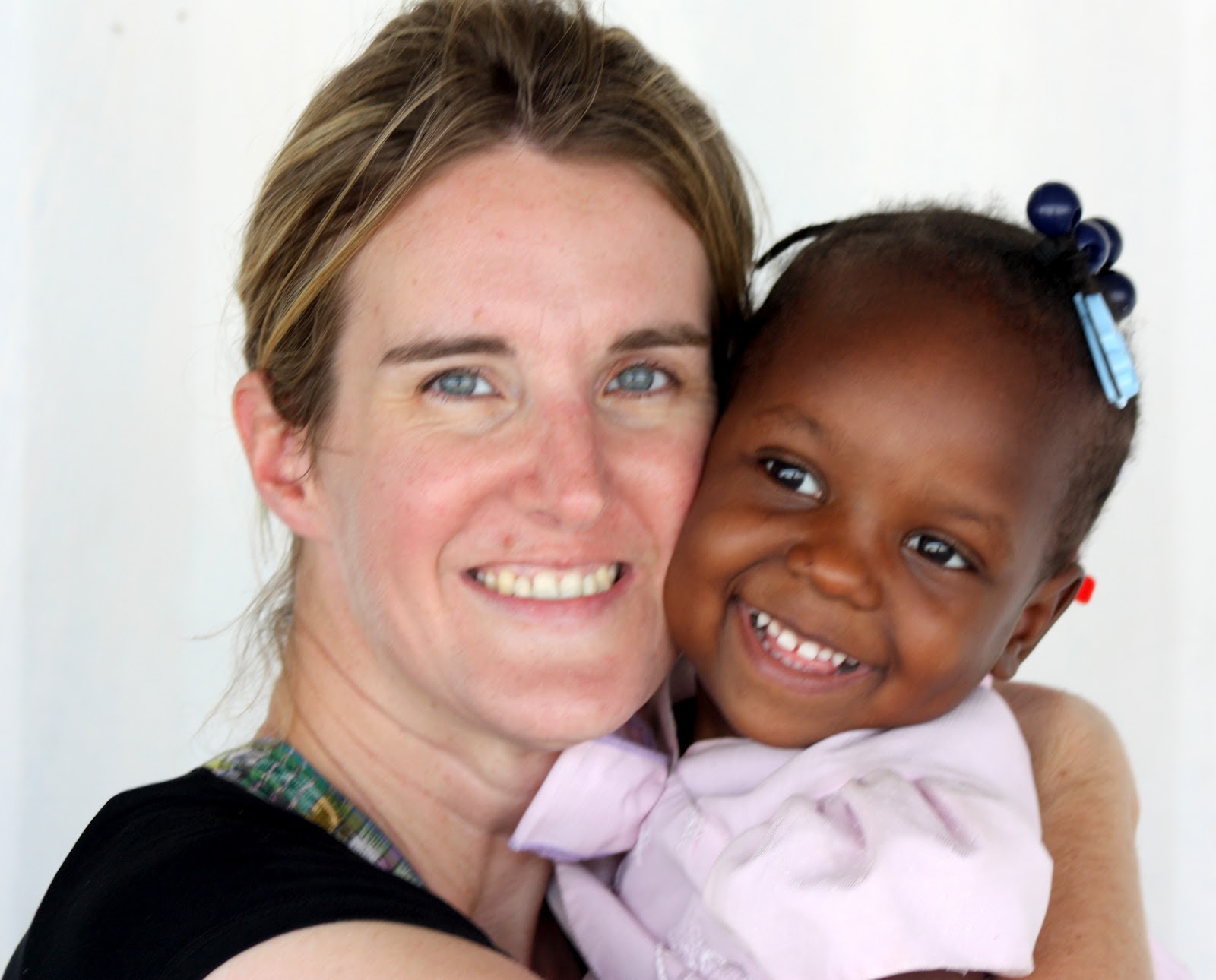 |
| My little girl and me |
I have been reflecting on this year – yes, it’s a year –
that I have lived this life, walking the dust-thickened streets, learning a new
and evolving language, looking into the eyes of a broken people who cry for
recognition, hearing stories of unimaginable courage and recovery from
circumstances beyond definition. I spend my restless nights praying that in my
imperfection, weakness and humanness I have somehow demonstrated a tiny glimpse
of the perfect Love which called me here. I have been blessed to love dozens of
children and be infected with the contagious joy that is an inevitable product
of any time spent with them. I have learned grace and humor and gentleness as I
have sat in awe of three extraordinary nurses who juggle the exhausting task of
caring for 800 children. I have challenged their thinking, and they have
countered with assertive questions and willingness to accommodate new
approaches and interventions. They are tireless and courageous heroines.
I have been impacted by a series of pint-sized heroes as
well. For a month, Ronald endured the daily irrigation and debridement of his
infected legs, dutifully coming to the clinic and smiling despite the pain, strictly
following his medication regimen and carrying the responsibility on his
eleven-year-old shoulders. Mama, a thirteen-year-old with a past completely
devoid of love, is passionately fighting a life-threatening disease, and every
day she challenges herself to believe that she is worth that fight.
Four-year-old Valson, abandoned in the cholera hospital and with neurological
damage from a birth-trauma injury, hates to sit still. When I take his hands
and he rises to stand, his smile is surreal. His mouth opens wide and he laughs
as we walk together. Rosenie, five, holds tightly to my arm as she watches my
every move. She yearns to be touched and held and wants my undivided attention.
She mimics me but instantly drops the act to help me carry supplies as we
organize the medical depot. Stanley, my six-year-old dose of human sunshine, is
literally the happiest kid in the world. Just looking at him draws laughter,
and he gently helps Stevenson navigate his way through a soccer game. They camp
out in the clinic, breaking into Michael Jackson-esque dance moves and singing
to the Christian songs on the radio. Seven-year-old Ubenson, attending the
summer program, now makes daily visits to me, playfully demanding a vitamin and
telling me how he saved the little packet of saltine crackers from yesterday.
He begs on the street every afternoon after school, sitting outside the UN
gates and eating the scraps from the food vendors. It is the only meal he will
get today. We sit and talk, and he smiles hugely when I offer him a glass of
cold water. “I want to live here with you,” he says. My heart breaks.
 |
| Ruth-Love, Rose-Berline, Aquila and Djenni loving their new bedroom! |
I was privileged to spend this year with an amazing and
generous roommate, my friend Dani. She came to Haiti with a determination and
willingness to do whatever needed to be done. And she conquered – embracing her
duties and organizing a literal mountain of donations and supplies. She
befriended and honored her coworkers, encouraging them and challenging them to
rise to responsibilities she knew they could fulfill successfully. She spent
nearly every evening with the hospitalized children abandoned by their
families, laughing with them, teaching the toddlers to walk, seeing the trauma
behind their eyes and comforting them with steadfastness and gentleness. She
was a patient and understanding confidante, who graciously broadened my
cinematic horizons and always had a song to fit the mood of the moment. She has
just returned to the States to join the ranks of the best nurses I know. She
has changed the world and will continue to do so.
After reading the previous paragraphs, you may be realizing
that my journey here in Haiti is not over – The month of August will be spent doing
substantial fundraising, attending weddings, being with some of my dearest
friends and attempting to adjust to American life. I will then return to serve the children, having tentatively committed to volunteer for an additional year. I say
tentatively because, as Haitians well know, Si
Dye vle (if God wills) is the mantra at the end of every day. There is
still much work to be done, and for the time being, my heart remains here. I am
excited to spend this next year empowering my nurses with education and
support. I also hope to assist in starting a Palliative Care program at St.
Damien hospital.
 |
| Dani and Marvens |
When I arrived in Port-au-Prince a year ago, I did so with
the knowledge that I truly did not know what would happen when that year was
over – although certain friends will tell you they predicted that one year
would not be enough. I ask them to hold their “I told you so’s,” as every day
is a series of emotional and physical experiences that would tire the most
agile and fit of humans. Hope must be a permanent fixture in the heart and mind
of any visitor here, as the blatant poverty and chaos are easy distractions
from the steady, sometimes muffled drumbeat of progress. It moves perhaps at a
slower pace than we instant-gratification conditioned Westerners might think
necessary, but it is progress nonetheless. And when it seems that hope is lost
for the moment, or that good will not win out over evil, the remedy is simple:
a quick walk to St. Louis or Ste. Anne, and a glance at any one of hundreds of
joy-filled faces. Their eyes reflect their determined hearts.
Heavy against the
darkness the joyful dancing steps of the children, who embrace even the newest
stranger with accepting arms too small to contain their excitement. The Light
which will not be overcome has been set ablaze and presented to them, and they
chase after it and stand in its warmth. Its radiance is infectious, softening
my heart and opening my hands as little fingers intertwine around mine, pulling
me forward.
Monday, July 2, 2012
The Haiti you Don't See
A dear friend sent me a few songs via iTunes, one of which struck
me particularly. As I searched the artist and read about the song on her
website, I was fascinated by the impetus behind it – it was written as a prayer
to God, that He wrap His arms around the world and protect the little ones who
are trapped in the horrible web of human slavery. Be it to the sex trade, to
poverty, to ignorance, to abuse, to greed, to history, to the silly 8-track
tapes full of lies which often find their way back into our conscience, we are
all impacted by slavery of some kind. I have no intent of belittling the true,
disgusting and very real issue of humans trapped in slavery to other humans –
it is a part of the culture here in Haiti, the children who are sold or given
into a life of forced service of every imaginable kind. But at the same time,
the daily battle I know that I fight against the lies implanted in my mind by
my own history, the fear of becoming numb to the desperate voices and scenes
that pass my ears and eyes, the truth of that statement that those ignorant of
their own history are doomed to repeat it – all of these are forms of slavery
as well.
Haiti is a broken country. Haiti has been broken by years of regimes
and foreign occupation which have, sadly, had similar endings. Then add a
devastating earthquake and a cholera epidemic to the mix, and you have the
makings of a terribly depressing story. But what never makes the headlines,
especially two years after the disastrous events which brought images and
stories to the forefront of the media and the world’s stage, is the freedom and
the joy that is present in this culture, the happiness and redemption and
healing that are happening. Scandal and horror stories sell; positive, quiet and
gradual change not so much. Do a Google-search on Haiti and you will encounter
images of riots, the earthquake and its aftermath, the garbage-flooded waters
of Cite Soleil, the unrest of a desperate people. What you will not see are the
photos and stories of new small businesses, the beginnings of sanitation
projects, the grants given for agricultural education, the shrieks of joy and
laughter of the children who receive their report cards and are thrilled to
know they are admitted to the next year of classes at school. You will not see
pictures of a brand-new home, just finished for the youngest members of the
Angels of Light program, painted with bright colors and with massive space to
run and play, a full beautiful kitchen and large bedrooms to accommodate up to
10 children. You will not learn of the fully-functioning hospital in the midst
of the poorest neighborhood in the Western hemisphere, with a clinic and staff
to treat the victims of cholera and poverty. You will not hear the determined
cries of the newborns at the maternity unit in the best pediatric hospital in
the country, nor will you witness the amazing transformation that occurs in the
lives of the severely malnourished children who are served by the nutrition
program. The abandoned children who know love through the dedication and daily
visits of short-term visitors and long-term volunteers – these children will
not be the next headline. But their smiles and uplifted arms as they take hold
of the generous hearts which parade them around the hospital their determined
steps damning the physical adversity which has threatened to stifle their
opportunity, have a lasting impact on the few privileged people who take the
time to meet them, changing the world and shattering stereotypes through the
simplest encounters.
My heart is saddened by the ignorant comments and questions posed by
those who, after a few days’ sojourn, believe they understand the people of
this country and claim to fully know the feelings and emotions of a Haitian who
has lived a life facing obstacles beyond an American’s imagination. Those who
choose to visit other cultures while tightly gripping their own egos and
insecurities, trying to justify ignorance or disdain by using stories of
statistics and joining the “poverty tourism” bandwagon, with self-serving
motives and intent to feign heroism while telling tales of chaos and posting
exploitative images of a broken people – they are slaves. I have been humbled
over and over again by the children who break my heart with the full impact of their
hugs, who stand proudly in their kindergarten graduation caps and gowns, who fill
the hollows of their metal dormitories with their yells of excitement at the
arrival of new friends, who can be perfectly contented for a few minutes doing
mathematics drills by adding and subtracting rocks, who use the stubs of
pencils until they are absolutely decimated, who treasure the gift of a used
matchbox car and score soccer goals using oversized Legos.
It is easy to observe the slavery that exists here, a people enslaved
to years of repeated history, who are forced into a culture of dependency which
has been promoted by organizations offering short-term solutions to long-term
problems, who are trapped in economic poverty and living day-to-day, if God
wills that tomorrow should come. It is easy to get caught up in the appearance
and blatant effects of brokenness which are immediately observable. The challenge
is to see past the presumed slavery of hearts and minds, and to work alongside
the untiring citizens who refuse to be bonded by the captivity of material and
educational poverty, to meet the earnest gaze of the children who smile
infectiously and excitedly reach across the divide to touch your hands. They
rise to meet each morning with its brutal heat and blanketing dust, and they
march against the tide of the last two hundred years. They stand in solidarity
with their friends, sharing the few resources they have. They sacrifice long
hours searching for employment and selling wares on the street, so that their
children can have a chance to break the cycle of history. They cherish each
other and work at a slower pace, which can be frustrating to us, the American
business-minded and frantic ones, but they are in a way more free than we are.
They live life in the present, passionately and vibrantly. They treasure
conversation and crave dignity. When asked, “How are you?,” their common
response is, “I am very well, with God.” They face their tomorrows with a faith
and resolve that puts mine to shame.
From babies hidden in the shadows
to the cities shining bright
There are captives weeping far
from sight
For every doorway there’s a story
and some are holding back the
cries
but there is One who hears us in
the night
- Christy Nockels
Subscribe to:
Posts (Atom)