Sunday, July 29, 2012

The Definition of a Hero


This morning, I excitedly walked to the new Kay Ste. Anne. I relish the fact that it is now just a 10-minute walk from St. Louis, and the best part of my recent mornings has been sitting and talking with the littlest members of the Angels of Light program. However, this morning there was a tinge of sadness mixed with my anticipation. I am about to travel Stateside for the month of August, and as ready as I am for a bit of a breather, I am also saddened that I will miss my babies for so many weeks. Crazy, is it not, that I could be in love with so many little ones – 184, to be exact! The laughter of little Erline as she sees me and the flap of her sandals as she runs down the corridor to wrap her arms around my legs – I do not know that there is a better sound or balm for my heart. The pack of little bodies that descends on me, eagerly tearing into my hair, commenting on its length and volume, arguing about who gets to braid it this time. Their hysterical shrieks as little hands pinch my nose and marvel at the change in my voice. Their sweet concerned expressions as I tell them that I am going away for a little while, their only question being whether I will come back, their smiles when I answer positively. The sticky, mango-laden hands and faces that I kiss goodbye at the end of the morning.
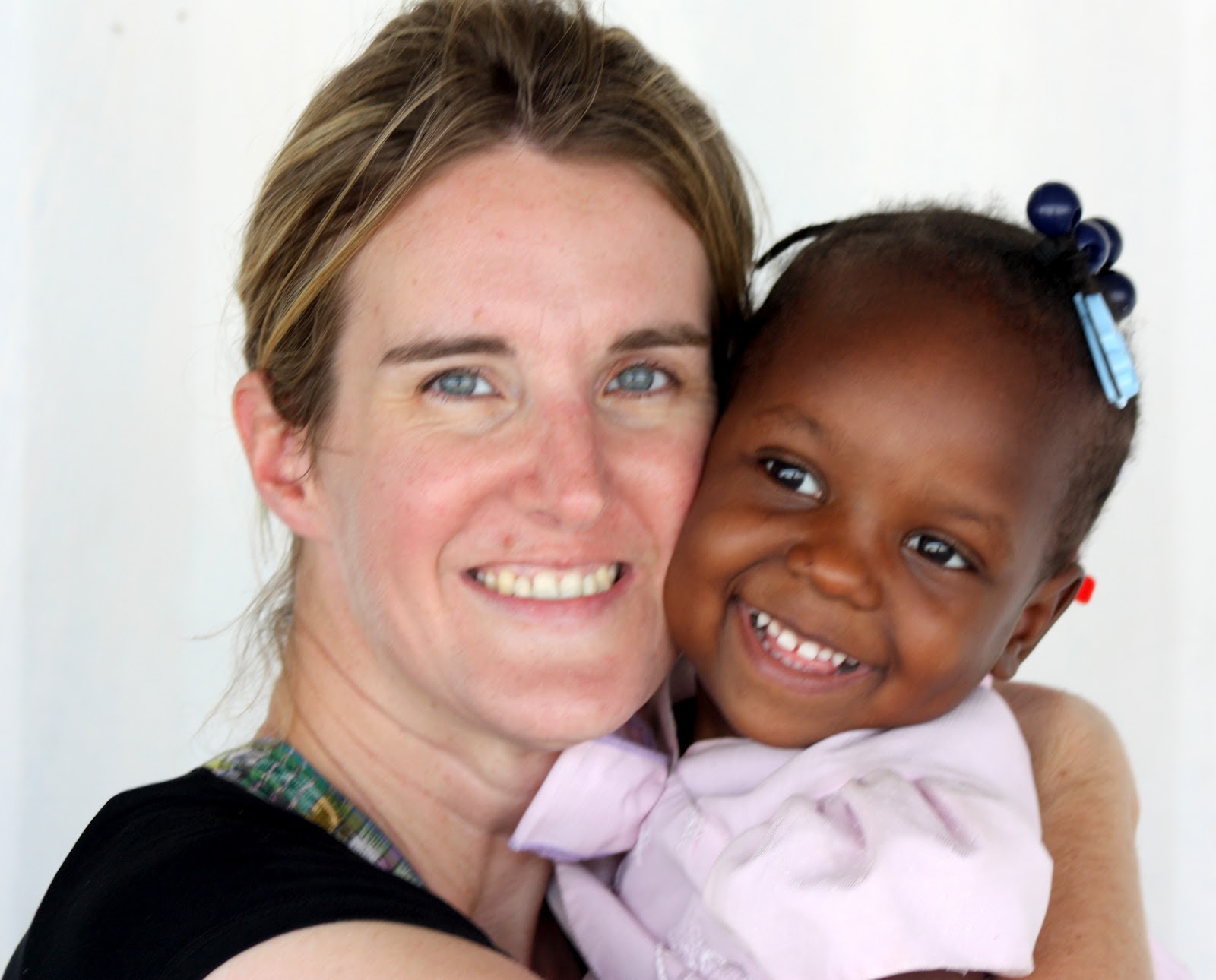
My little girl and me

 I have been reflecting on this year – yes, it’s a year – that I have lived this life, walking the dust-thickened streets, learning a new and evolving language, looking into the eyes of a broken people who cry for recognition, hearing stories of unimaginable courage and recovery from circumstances beyond definition. I spend my restless nights praying that in my imperfection, weakness and humanness I have somehow demonstrated a tiny glimpse of the perfect Love which called me here. I have been blessed to love dozens of children and be infected with the contagious joy that is an inevitable product of any time spent with them. I have learned grace and humor and gentleness as I have sat in awe of three extraordinary nurses who juggle the exhausting task of caring for 800 children. I have challenged their thinking, and they have countered with assertive questions and willingness to accommodate new approaches and interventions. They are tireless and courageous heroines.

I have been impacted by a series of pint-sized heroes as well. For a month, Ronald endured the daily irrigation and debridement of his infected legs, dutifully coming to the clinic and smiling despite the pain, strictly following his medication regimen and carrying the responsibility on his eleven-year-old shoulders. Mama, a thirteen-year-old with a past completely devoid of love, is passionately fighting a life-threatening disease, and every day she challenges herself to believe that she is worth that fight. Four-year-old Valson, abandoned in the cholera hospital and with neurological damage from a birth-trauma injury, hates to sit still. When I take his hands and he rises to stand, his smile is surreal. His mouth opens wide and he laughs as we walk together. Rosenie, five, holds tightly to my arm as she watches my every move. She yearns to be touched and held and wants my undivided attention. She mimics me but instantly drops the act to help me carry supplies as we organize the medical depot. Stanley, my six-year-old dose of human sunshine, is literally the happiest kid in the world. Just looking at him draws laughter, and he gently helps Stevenson navigate his way through a soccer game. They camp out in the clinic, breaking into Michael Jackson-esque dance moves and singing to the Christian songs on the radio. Seven-year-old Ubenson, attending the summer program, now makes daily visits to me, playfully demanding a vitamin and telling me how he saved the little packet of saltine crackers from yesterday. He begs on the street every afternoon after school, sitting outside the UN gates and eating the scraps from the food vendors. It is the only meal he will get today. We sit and talk, and he smiles hugely when I offer him a glass of cold water. “I want to live here with you,” he says. My heart breaks. 

Ruth-Love, Rose-Berline, Aquila and Djenni loving their new bedroom!
 I was privileged to spend this year with an amazing and generous roommate, my friend Dani. She came to Haiti with a determination and willingness to do whatever needed to be done. And she conquered – embracing her duties and organizing a literal mountain of donations and supplies. She befriended and honored her coworkers, encouraging them and challenging them to rise to responsibilities she knew they could fulfill successfully. She spent nearly every evening with the hospitalized children abandoned by their families, laughing with them, teaching the toddlers to walk, seeing the trauma behind their eyes and comforting them with steadfastness and gentleness. She was a patient and understanding confidante, who graciously broadened my cinematic horizons and always had a song to fit the mood of the moment. She has just returned to the States to join the ranks of the best nurses I know. She has changed the world and will continue to do so.

Dani and Marvens
After reading the previous paragraphs, you may be realizing that my journey here in Haiti is not over – The month of August will be spent doing substantial fundraising, attending weddings, being with some of my dearest friends and attempting to adjust to American life.  I will then return to serve the children, having tentatively committed to volunteer for an additional year. I say tentatively because, as Haitians well know, Si Dye vle (if God wills) is the mantra at the end of every day. There is still much work to be done, and for the time being, my heart remains here. I am excited to spend this next year empowering my nurses with education and support. I also hope to assist in starting a Palliative Care program at St. Damien hospital.

When I arrived in Port-au-Prince a year ago, I did so with the knowledge that I truly did not know what would happen when that year was over – although certain friends will tell you they predicted that one year would not be enough. I ask them to hold their “I told you so’s,” as every day is a series of emotional and physical experiences that would tire the most agile and fit of humans. Hope must be a permanent fixture in the heart and mind of any visitor here, as the blatant poverty and chaos are easy distractions from the steady, sometimes muffled drumbeat of progress. It moves perhaps at a slower pace than we instant-gratification conditioned Westerners might think necessary, but it is progress nonetheless. And when it seems that hope is lost for the moment, or that good will not win out over evil, the remedy is simple: a quick walk to St. Louis or Ste. Anne, and a glance at any one of hundreds of joy-filled faces. Their eyes reflect their determined hearts.

Heavy against the darkness the joyful dancing steps of the children, who embrace even the newest stranger with accepting arms too small to contain their excitement. The Light which will not be overcome has been set ablaze and presented to them, and they chase after it and stand in its warmth. Its radiance is infectious, softening my heart and opening my hands as little fingers intertwine around mine, pulling me forward.

Monday, July 2, 2012

The Haiti you Don't See


A dear friend sent me a few songs via iTunes, one of which struck me particularly. As I searched the artist and read about the song on her website, I was fascinated by the impetus behind it – it was written as a prayer to God, that He wrap His arms around the world and protect the little ones who are trapped in the horrible web of human slavery. Be it to the sex trade, to poverty, to ignorance, to abuse, to greed, to history, to the silly 8-track tapes full of lies which often find their way back into our conscience, we are all impacted by slavery of some kind. I have no intent of belittling the true, disgusting and very real issue of humans trapped in slavery to other humans – it is a part of the culture here in Haiti, the children who are sold or given into a life of forced service of every imaginable kind. But at the same time, the daily battle I know that I fight against the lies implanted in my mind by my own history, the fear of becoming numb to the desperate voices and scenes that pass my ears and eyes, the truth of that statement that those ignorant of their own history are doomed to repeat it – all of these are forms of slavery as well.

Haiti is a broken country. Haiti has been broken by years of regimes and foreign occupation which have, sadly, had similar endings. Then add a devastating earthquake and a cholera epidemic to the mix, and you have the makings of a terribly depressing story. But what never makes the headlines, especially two years after the disastrous events which brought images and stories to the forefront of the media and the world’s stage, is the freedom and the joy that is present in this culture, the happiness and redemption and healing that are happening. Scandal and horror stories sell; positive, quiet and gradual change not so much. Do a Google-search on Haiti and you will encounter images of riots, the earthquake and its aftermath, the garbage-flooded waters of Cite Soleil, the unrest of a desperate people. What you will not see are the photos and stories of new small businesses, the beginnings of sanitation projects, the grants given for agricultural education, the shrieks of joy and laughter of the children who receive their report cards and are thrilled to know they are admitted to the next year of classes at school. You will not see pictures of a brand-new home, just finished for the youngest members of the Angels of Light program, painted with bright colors and with massive space to run and play, a full beautiful kitchen and large bedrooms to accommodate up to 10 children. You will not learn of the fully-functioning hospital in the midst of the poorest neighborhood in the Western hemisphere, with a clinic and staff to treat the victims of cholera and poverty. You will not hear the determined cries of the newborns at the maternity unit in the best pediatric hospital in the country, nor will you witness the amazing transformation that occurs in the lives of the severely malnourished children who are served by the nutrition program. The abandoned children who know love through the dedication and daily visits of short-term visitors and long-term volunteers – these children will not be the next headline. But their smiles and uplifted arms as they take hold of the generous hearts which parade them around the hospital their determined steps damning the physical adversity which has threatened to stifle their opportunity, have a lasting impact on the few privileged people who take the time to meet them, changing the world and shattering stereotypes through the simplest encounters.

My heart is saddened by the ignorant comments and questions posed by those who, after a few days’ sojourn, believe they understand the people of this country and claim to fully know the feelings and emotions of a Haitian who has lived a life facing obstacles beyond an American’s imagination. Those who choose to visit other cultures while tightly gripping their own egos and insecurities, trying to justify ignorance or disdain by using stories of statistics and joining the “poverty tourism” bandwagon, with self-serving motives and intent to feign heroism while telling tales of chaos and posting exploitative images of a broken people – they are slaves. I have been humbled over and over again by the children who break my heart with the full impact of their hugs, who stand proudly in their kindergarten graduation caps and gowns, who fill the hollows of their metal dormitories with their yells of excitement at the arrival of new friends, who can be perfectly contented for a few minutes doing mathematics drills by adding and subtracting rocks, who use the stubs of pencils until they are absolutely decimated, who treasure the gift of a used matchbox car and score soccer goals using oversized Legos.

It is easy to observe the slavery that exists here, a people enslaved to years of repeated history, who are forced into a culture of dependency which has been promoted by organizations offering short-term solutions to long-term problems, who are trapped in economic poverty and living day-to-day, if God wills that tomorrow should come. It is easy to get caught up in the appearance and blatant effects of brokenness which are immediately observable. The challenge is to see past the presumed slavery of hearts and minds, and to work alongside the untiring citizens who refuse to be bonded by the captivity of material and educational poverty, to meet the earnest gaze of the children who smile infectiously and excitedly reach across the divide to touch your hands. They rise to meet each morning with its brutal heat and blanketing dust, and they march against the tide of the last two hundred years. They stand in solidarity with their friends, sharing the few resources they have. They sacrifice long hours searching for employment and selling wares on the street, so that their children can have a chance to break the cycle of history. They cherish each other and work at a slower pace, which can be frustrating to us, the American business-minded and frantic ones, but they are in a way more free than we are. They live life in the present, passionately and vibrantly. They treasure conversation and crave dignity. When asked, “How are you?,” their common response is, “I am very well, with God.” They face their tomorrows with a faith and resolve that puts mine to shame.

From babies hidden in the shadows
to the cities shining bright
There are captives weeping far from sight
For every doorway there’s a story
and some are holding back the cries
but there is One who hears us in the night

- Christy Nockels

Saturday, June 23, 2012

Little Moments

Vaccination Campaign, round 3. That's Dani, my roommate and future nurse!

Francheese, resting peacefully while awaiting baptism

Mama with her proud godparents! Her godfather is Kenson Kaas, Director of the Angels of Light program

Post-baptism snack

Goofy girls Wideline, Metecha, Celianne and Metechaya
Words have not come easily as of late – the excitement of the first several months has morphed into the routine of each day, the intensity of this world often overwhelming with its constant battles to find hope and facilitate progress. I find it more difficult to relate my thoughts and emotions. The sheer volume and magnitude of differences between this life and the life of the Western world present themselves in conversations with short-term volunteers, in brief visits with friends on a recent trip back home, in the plethora of modern conveniences available as soon as the plane lands in Miami, in the headlines which pop up on our computer screens each morning, in the dust-filled chaos that is my walk to work.

In the midst of the sobering moments like these, I relish in the little moments and small victories which make each day here such a wholesome experience. Some may have been mentioned in previous posts, but I find them worth mentioning again. They are priceless.

  • Stevenson making the sign of the cross before attempting to write his name. Sitting with him as he talks through and studiously practices writing his numbers, all the way through 100:
“I can’t do it!”
“Don’t tell me you can’t do it, Stevenson. You CAN do it! You know!”
“Wait! I can do it!” ….“Look, Brigitte! I did it!”
  • Being complimented on my Creole.
  • Sharing a long, side-splitting laugh with my nurses.
  • The gaggle of children standing in the doorway of the clinic each afternoon.
  • Ti Erline reaching up for me, playing with my camera as she sits on my lap. She taps me lightly on the arm as she scrolls through the pictures, wanting me to see each one.
  • Completing vaccinations for all 184 of the FWAL kids, fully immunizing them against Hepatitis B, Meningitis, Measles, Mumps, Rubella, Tetanus, Diptheria, Pertussis, and Polio.
  • Finding Starbucks Java Chip Frappucino ice cream at the supermarket.
  • The chorus of little voices chanting, “Brigitte! Brigitte!” as the bus pulls into the driveway of Ste. Anne.
  • Watching newly-baptized Erline eat a slice of watermelon.
  • Sitting with Mama as she starts to make sense of her diabetic symptoms.
  • My daily 5-second check-in with Wangly: "Brigitte, are you good?" "Yes, Wangly, I'm good. Are you good?" "Yup! Bye!"
  • Passing by the bus to Ste. Anne as the kindergartners are rounded up at midday, high-fiving them as they yell my name and pass their hands out the window.
  • “Brigitte, I have a headache.”
“You need to drink a glass of water – many glasses of water. Your body needs water. It is very hot out here!”

“I can’t drink water. Water makes you fat!” 
  • Reading “Alexander and the Terrible, Horrible, No-Good, Very Bad Day” in Creole, trying to explain to the kids that the picture doesn’t actually show the gum in Alexander’s hair. Stevenson begging me to re-read it to him until he can memorize the whole story.
  • Drilling Miss Boisrond in her English exercises, helping her pronounce the parts of the body.
  • Little hands running through my hair and stroking my arms, tracing the veins in my hands.
  • Stanley checking on me after a bee sting: “Brigitte, does your back still hurt?” “No, thank you so much for asking! My back is all better.” “Oh good.” (Huge smile follows).
  • Joking with the kids after my return from a trip: Me: “Did you miss me, or did you miss the candy I bring?” Mike, 6 years old, after a brief pause: “Umm, we missed you both!”
  • Getting the phone call that the years’ supply of medications we have been awaiting since January has finally arrived!
  • A cold shower at the end of a long, sweaty day.
  •  The restaurant actually having my first choice on their menu available. (For the first several months I was here, it was a running joke – I would go through two or three rounds before my order could be completed!)
  • The schoolchildren who enthusiastically call my name as we pass on the street, and the giggle that passes through their lips as I respond.
  • Gouda cheese quesadillas and peanut M & M’s.
  • A week in Mexico, refreshing my Spanish, remembering my first love of Latin American culture and finding solidarity with my compatriots from the other NPH homes.
  • A thank-you note from Islandy, written painstakingly in French cursive.
  • Staring at the newly-donated piano, trying to remember any of the songs etched into my head by years of lessons, as the boys beg me to play them something. (Sorry, mom! I could not remember how that Bach started ... I could remember the rest, just not the beginning!)
  • Being asked by Mama to be her godmother, finding out that I am also the godmother for another precious FWAL kiddo, Valson. Sitting on the floor during the baptism service while Valson wraps his arms around my neck and smiles hugely at me.
  • Haitian 7Up

Sunday, May 20, 2012

Fotos nan Lavi Ayisyen

I am in the midst of preparing a written entry, but in the meantime, here are some pictures displaying some of the reasons I am so compelled to be here.

Mosquito nets arrived at the beginning of this month! This is a huge blessing and accomplishment, as malaria has been a frequent visitor to FWAL. From left: Stevenson, Maxuel, Mike and Richardson

My pupil Stevenson and me, doing memory drills

Staelle, Thamara and Fabienne waiting patiently for their Easter presents

My name, written by Stevenson. (Brigitte is the French spelling, which I use here).

We had a baby! Francheese, 3 months old and named after a fabulous Italian Nurse Midwife volunteer, came to Ste. Anne last week. She is beautiful, healthy and growing well!

Antoine and Rose-Berline, Ste. Anne kiddos

My precious girl Erline. We sit together every time I am at Ste. Anne, and she immediately takes my hair down from my ponytail and runs her hands through it for hours on end. She is happy, so very gentle and compassionate.

Sweet patient at St. Damien, the best (and free) pediatric hospital in Haiti.

Fr. Rick, at morning mass, which is most often a funeral. He is committed to honoring the dead from the hospitals, giving them a dignified memorial and burial. "What they did not have in life we must give them in death - respect and peace."

A few of the precious little ones from the Abandoned Room - Lubin, Carly, Lourdy and Naika (peeking behind Lourdy).

Tuesday, April 24, 2012

Letters with Stevenson


It is easy to feel overwhelmed with the sheer magnitude of the problems of poverty. I have witnessed the undoing of many well-meaning individuals and organizations who have entered the fray of the developing world with wonderful, but short-sighted or self-centered intentions. I marvel that I have been here nearly one year, and that this life has become so normalized for me. The creature comforts of home still remind me of how I miss them. 

I am currently in Mexico, having had an overnight layover in Miami and running into Target for a few necessities – and no matter how much I try to prepare myself, it is a ceaseless amazement to me that there is such a plethora of items there. But thank goodness for one-stop shopping, a luxury that is not to be found in Haiti. Running errands with Joanne a few weeks ago, as we searched through the various NGO’s serving in Haiti hoping to find a supplier of mosquito nets, we did stop at the most well-stocked supermarket I had seen in my eight months’ assignment, but still we had to travel to at least three more stores to find esoteric items such as staplers and digital memory cards (which, after import taxes, ran at least double the price in the States).

In the midst of a stretch of months where many projects seem to be nearing their completion – well, I am glad you asked! Of course I am glad to share the accomplishments of my team with you – we have completed the admission lab work for all of our children, a huge feat in just a few short months; we have begun keeping regular monthly statistics via computer, we will be completing the third round of supplemental vaccinations next month, 38 of our children who tested positive on their Mantoux TB tests are now on prophylactic medication, we have done basic vision testing on nearly all of the kids, which will also be completed within the month, we finally have mosquito nets for everyone at the home!!!!! (Special thanks go to the NPH German office for their work in securing the donation), and we will be receiving a massive order of medications which should supply us for the next 12 months. (Again, thanks to the German offices for their generosity in covering the cost of these medications). As of this week, all of the children will have had a visit with the dentist - Dental services are offered at St. Damien hospital, free of charge, for which we are very grateful and blessed! We will also soon be moving to a bigger container, which will give us double the clinic space and also will allow a private sleeping space for the nurses, storage, and a more peaceful environment for our patients. 

Perhaps the most encouraging accomplishment was the completion of a nutrition program we implemented in October. We identified 58 children who were significantly underweight and under-height for their ages. Over the next five months, those children received a supplemental meal every day at 10:00 am, the time of their school break. We monitored heights and weights monthly. Some children were able to leave the program, while others were brought in due to weight loss. Just last week, we re-weighed everyone that has ever been in the program, and I am thrilled to report that over five months, we had a total of 65 children receive extra food. As of today, only 9 remain significantly underweight! That is a massive improvement, and was a huge encouragement to the nurses, the directors and myself, as 86% of the children drastically improved and are now back on the growth curve!

And now to the original purpose of this post – and the addition of “teacher” to my resume. As we were commencing with the vision tests of all the kiddos last month, Stevenson came to me and insisted that we had to check his eyes too. A part of me wanted to laugh, as he has a congenital defect which has been diagnosed here in Haiti as Ocular Muscle Atrophy. He is nearly blind and can distinguish some colors, but not all, and most certainly could not read or write. He was at the FWAL school for many months, but understandably was inattentive in class and was deemed a poor student. A side challenge of the educational system here in Haiti is that there is no individual attention given, and instruction is given via memorization the majority of time. After we obtained an appointment with an ophthalmologist and were given the diagnosis mentioned above, it was decided that we would send Stevenson to a school for the blind, starting in January. 

Stevenson (Left) and a friend at Kay St,. Louis
 Stevenson is a wonderfully sweet and attentive child, desperate for attention and often acting out because he is so frustrated with the inability to apply himself to constructive activities. He loves to learn, and was able to dance the Cupid Shuffle with me after only a few lessons! He still asks to dance, and reminds me when I have not brought my music for many weeks. As times, I will admit, his constant presence at my side and his violent actions to keep my attention were an annoyance to me, but at the same time, I wondered how this intelligent little guy might be able to learn.
After he started school, I asked him daily what he had learned. He continuously said, “Nothing,” and “they don’t talk there.” He was still bored, frustrated, anxious and easily irritated. For the next two months, his answers remained the same, and he could not tell me anything he had learned. Was he reading Braille? Could he see enough to read or write? I knew nothing. I was frustrated for him, as it seemed that the venture into special education was proving fruitless. 

So, the day of the vision test, to humor Stevenson, I decided to go ahead and test his vision with the basic picture eye chart. To my surprise, he could see the largest line – the equivalent of 20/100 vision, with his right eye! Sadly his left eye could not distinguish the pictures. But after seeing that he could recognize the largest items on the chart, I started thinking – if he can see large pictures, why not large letters? I asked Stevenson, “Do you want to learn how to write?” And you can guess his response! So commenced my latest project. I created large letters, colored with bright colors in permanent marker, on pieces of construction paper. We started at the beginning of the alphabet, and covered one to two letters per day, learning both the capital and lowercase letters. I had to double check many times how to write the lowercase, as here in Haiti cursive writing is still taught as the primary form. This makes me happy, as my friends and anyone who has received anything in written form from me will testify. I still love writing in cursive! And will keep up the protest, as our crazy modern age slowly picks away at penmanship skills. The change in little Stevenson was amazing to observe – he was excited, and happy, and embraced the challenge. It has been difficult for him at times, as he still cannot see well once he has written something on paper – he is doing most of his writing by feel and repetition. But the smile on his face when he was able to start writing people’s names was fabulous. He sings to the letters, laughs at me when I ask how to write a certain letter in Creole versus English, remembers incredibly well when we have our daily quizzes, and can recognize every letter. “Show me the other one,” he says when he cannot quite remember.  The other nurses and even a few of the other children have participated too, patiently waiting while he concentrates and writes each letter. Once the children see how excited Stevenson is, their interest compounds!

 I was close to tears when he wrote my name over and over, trying to get it perfect. He runs up to me every afternoon when I arrive, asking which letters we will practice today, and now that we have gotten to the end of the alphabet, he is anxious to learn his numbers. I am now determined to search for a better diagnosis, so that I know if we have considered every possible option for him. Thankfully, a CT scanner is functional at a neighboring hospital. But it is an absolute highlight of each of my recent days at FWAL, to see him changing and becoming a studious boy, hopeful and optimistic about his improving future. This is why I am here. Each day, more reasons are revealed to me. When I become doubtful or lonely, I can go find a little visually challenged boy and ask him to write his name. And now, after years of waiting, he can.

Saturday, March 24, 2012

Heavy


Heavy in my arms the three small bodies I carry into the chapel, nestling one against my elbow while gingerly holding another, still warm, in my hands. I place them alongside each other and cover them with a funeral pall. 

Heavy in my arms the now-healthy two-year-old boy who squirms to run and play, chasing after me and laughing, his face and belly filled out after months of extra nutrition. He is a radical contrast to the fragile, frightened child who rejected affection just a few short months ago.

Heavy in my mind the few short seconds of trembling earth, which jolt us to attention as we dash outside, and the subsequent nervous laughter audible from the hospital corridors as phone calls are frantically made.

Heavy in my heart the knowledge that though my precious little ones slept through the tremor, their bodies and minds still recognized it and caused them to dream vividly about the trauma they survived two short years ago.

Heavy in my arms the boxes of medical supplies, so generously donated, which will allow our newly diagnosed diabetic continued comfort as she adapts to a new routine and set of requirements, and which will provide safe and clean access to care for the children within the walls of the NPFS facilities.

Heavy in my arms the dozens of toys showered upon me by friends stateside, which will add to the Easter festivities for 200 kindergarteners. Heavy in my ears the shrieks of excitement from the director as she opens each bag and marvels at its contents.

Heavy on my lap the sturdy compact person that is Jerry, a newcomer to FWAL. He sits asking me endless questions and reciting observant facts about his new brothers and sisters, his hands grasping my arms and begging me to tickle him. “I won’t laugh,” he says, hardly able to contain his giggles.

Heavy in my eyes and ears the voices and faces of the desperate who reach out to me on the street, begging for assistance, money, food, employment, to be heard.  As I continue to walk and listen, looking into eyes and holding hands for brief moments, I pray that Hope keeps them standing.

Heavy on my roof the sounds of the bittersweet rains, which provide brief respite from the dust and heat, watering the vegetation while drenching the tent cities and flooding the streets with refuse. Heavy on the roads the following morning the trucks from St. Luc, loaded with food and supplies, which travel into the slums to assist those who suffer.

Heavy in the night the thoughts which wrestle with my desire to sleep, the wonderment and the weight of each moment not lost on the endless surfaces of my mind. They mix with the wails of the laboring women, the embodiment of this struggle to give birth to change, the cry of new life protesting the naysayers who claim there is no hope.

Heavy against the darkness the joyful dancing steps of the children, who embrace even the newest stranger with accepting arms too small to contain their excitement. The Light which will not be overcome has been set ablaze and presented to them, and they chase after it and stand in its warmth. Its radiance is infectious, softening my heart and opening my hands as little fingers intertwine around mine, pulling me forward.

Saturday, March 17, 2012

The Journey


The rainy season has sent notice of its arrival, with torrential downpours nearly every evening. I hear the thunder approaching as I sit down to write. I am told that the cooler weather will soon cease, though this prompts a smile because the only slight “cool” we have experienced has been a temperature drop of a few degrees at night. The days remain scorchingly hot, with full sun present, although a nice breeze has accompanied it for the last month. I am not at all complaining, mind you – I have gladly traded frigid winter temperatures for the Vitamin-D richness of the tropical sun on a daily basis. Additionally, for the first time, Haiti has joined the United States in the tradition of Daylight Savings Time. There was some concern that this might not be a success, as apparently it was tried during the time of the dictatorship many years ago and no one in the countryside knew of the change. But so far it seems that there was a successful transition. My father, who lives for the two days a year he gets to change the clocks, was overjoyed to hear that we were remaining in the same time zone! It is a treat to have a few more minutes in the morning before the sun rises to greet us. The Jordanian UN camp continues to broadcast the Call to Prayer before dawn, so that is my usual wake-up at approximately 5:00 am. I am fairly convinced that they recently turned up the volume on their speakers, however. I would certainly choose a different type of alarm given the option - The churning of the coffeemaker, for instance, is a much more pleasant alternative.  The sounds which inundate me during the course of a day are now part of a routine which has become the norm, as are the children from the streets who run to me as I leave the gates of the hospital, asking for a dollar in English, or yelling the few phrases they know in my direction.  Thankfully, a few of them know, “You are beautiful!” and “I love you!” which bring a little smile to my face when I wonder if they know what they are saying. The little ones sitting in their mothers’ arms stare intently at me as I walk by the triage tents, breaking into a toothy grin as I greet them in Creole and wave. It is still fun to surprise those I encounter on the street, when I respond to them in Creole. Negotiating the newly formed puddles on the rocky road, declining the motorcycle drivers as they encourage me to take a taxi to work, I relish my morning walk. The security guards call me “zanmi m’,” which means “my friend!” as I walk past the various gates of the NPH complexes and enter the cow fields to negotiate a different type of newly formed hazard. There are several new calves, which are adorably awkward as they stand on their long legs and hold their heads up between two huge ears! Their moms stand protectively over them or very closely by, eyeing me cautiously as I walk by, through the dust bowl which has recently become the practice field for student drivers. 

Countless moments occur every day, and I realized this past few weeks that I was holding many of them at arms’ length, because the amount of emotion that my heart and head experience is sometimes too overwhelming to face. As we joined the children at Kay Ste. Helene up in Kenscoff for the 25th Anniversary celebration of NPH’s work in Haiti, it was remarkable to see the group of former residents who have become active professionals, many of whom now work for NPH. They stood and were an active witness to the care and security and hope that NPH offers to the children in our charge. We listened to Fr. Rick share about the beginnings of NPH in Haiti and how God has blessed the organization with wonderful friends and servants. Many of the Angels of Light kids accompanied us – always an adventure in motion sickness for at least one of them! – and were able to join hundreds of their cohorts in song and worship. There are few things more beautiful than hearing a chorus of children singing together! And they sing with all their might. It is an instant lift to the soul.

 A more difficult emotional experience is the slow unveiling of the horrific histories of some of our children in the Angels of Light program. I will forever stand by my assessment that Haitian children are the most resilient of human beings, smiling and living with determined hope through unspeakable and unimaginable pain. I try to put myself into the mind of a 12-year old girl who has been passed from house to house as a restavec, or child slave, forced to sleep on the street and rise in the middle of the night to cook food which she is not allowed to eat. As symptoms of a chronic illness began to present themselves, she would be cast off again, until an acquaintance brought her to the hospital for care. Imagine facing life believing that you will be thrown to the street with the next mistake you make, your own mother having given you away when you were a young child. I look at the healed scars where whips once penetrated the skin of another young girl, who still shrinks away when I place my hand around her shoulders, her instinct still telling her that a touch cannot possibly be a gesture of comfort, but only of pain. I listen as a coworker recounts the story of two young sisters whose family simply stopped feeding them because their mother was no longer present in the home to watch over them. I look at the pictures of their starving bodies after NPH staff rescued them from their home, and I watch them now as they laugh and play happily, snuggling into the laps of the staff which nurtures, feeds and loves them. I accompany Dani to the abandoned chidrens' room at the hospital, where we meet children who have been left by their parents, whether out of desperation or other motive we cannot know. They stand, fight for toys and run for the exits when we ask if they want to tour the hospital. They greet us with smiles and laughter, and they wail in sorrow when we have to say goodbye for the evening. Such daily encounters are excruciating to negotiate, and I have not been terribly successful of late. But healing and joy comes in the full-body hug of a child who simply wants to be held, or in the myriad of languages and phrases accompanying the “thank you” of another little guy cherishing his glass of cold water, or the shrieking of a house full of babies who have just received a new pair of sunglasses, or the tiny voice of a little girl who says my name quietly as she gently runs her fingers through my hair. It is in the hands of the ones who caress mine, who ask again and again to dance the Cupid Shuffle, who yell my name when they see me approaching and break into a full-on run to greet me. It is in the slow walk through the yard of the baby house, with one child grasping each of my legs, another in my arms, and yet another pushing me from behind. It is in the smile of a nurse when I compliment her on a job well done, and the laugh of a shared joke. It is in the recitation of the universal prayers offered at mass every Sunday, in the embrace of peace given and received with sincerity. It is in the words of a little boy who says, “I am going to pray here, with you.” 

Sunglasses!!!!

Antoine, comedian.